

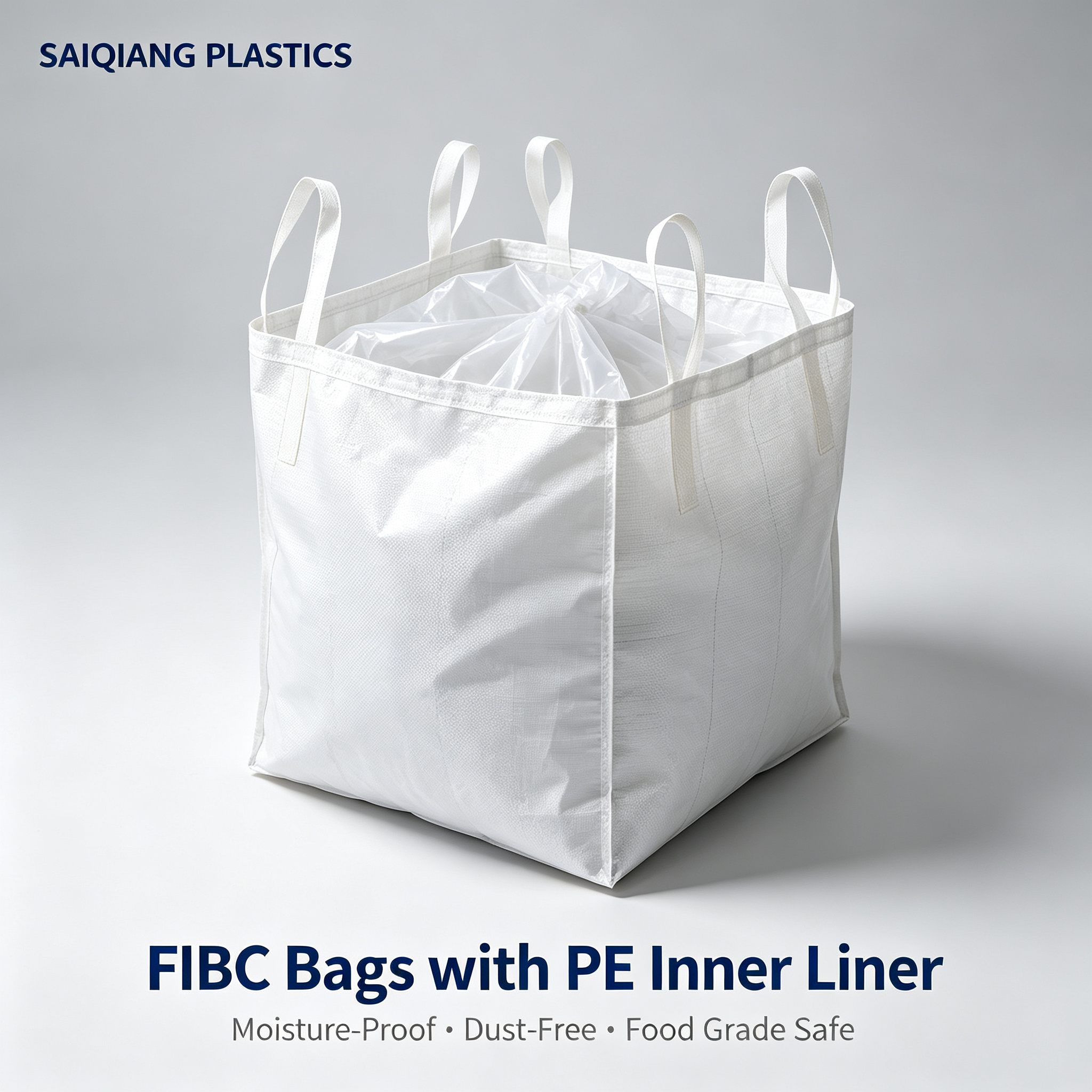
For moisture-sensitive powders, food ingredients and fine chemicals, an ordinary bulk bag is not enough. A fibc with pe liner places a sealed film barrier inside a heavy-duty woven shell, so the product never touches the fabric. The difference between a liner that protects the load and one that ends up torn inside the discharge spout is how it is fixed, and that is the part Zhejiang Saiqiang Plastic builds into every lined bag.
A bulk bag with an inner liner creates a sealed barrier between the product and the outside environment. That stops moisture pickup during sea freight, keeps fine powder from sifting through the weave, and gives a clean, hygienic bulk bag surface for food and pharmaceutical use. In a standard unlined bag the fabric is the barrier, and woven PP is breathable by construction; a liner turns the same outer shell into a closed container without changing its lifting geometry.
Our food grade bulk bag liners are virgin LDPE or LLDPE, from 50 to 200 microns, heat-sealed to the inside of the outer bag. Thickness is chosen by how sensitive the load is, not by how much the film costs:
| Liner thickness | Barrier level | Typical products |
|---|---|---|
| 50–80 µm | Standard moisture barrier | Seeds, grains, feed additives |
| 100–150 µm | High moisture and dust barrier | Milk powder, food additives, fine chemicals |
| 150–200 µm | Maximum barrier for hygroscopic loads | Pharmaceutical ingredients, pigment powders |
A lined bag keeps the full strength of its circular woven or flat woven outer shell. The standard outer is 160–220 gsm UV-stabilised PP fabric with a 5:1 safety factor, available at 500, 1000, 1500 and 2000 kg safe working load, and 6:1 on request. The liner adds no weak point: it is heat-sealed to the wall, so the load path still runs through the corner seams and the 70 mm lifting loops rather than through the film.
Three details decide whether a liner for jumbo bag use survives the first fill. First, fixing: a heat-sealed liner cannot slide down or tear at the fill point, which matters on spout filling where a loose liner would be pulled into the stream. Second, top closure: a dust-tight tie-string or heat-sealed top keeps humidity out after filling, and without it the liner only protects the product until the bag is opened. Third, discharge: for bottom-spout discharge the liner is cut and folded so the spout stays clear, while tipping discharge needs the liner bonded at the base as well as the wall.
The first is choosing thickness by price: a 50 µm liner is right for grain and wrong for a hygroscopic pigment that will sit in a container for six weeks. The second is ordering a loose liner for a powder that will be discharged through a spout, where the film will block the opening. The third is treating food contact as automatic: our liner is FDA compliant and suitable for direct food contact, but the certificate has to be requested with the order so it ships with the batch documents. The fourth is silence about regulated goods. If your product is classed as a dangerous good, say so at inquiry stage, because a un certified bulk bag is a separate construction and rating from a standard food-grade lined bag and cannot be added afterwards.
Capacity, liner thickness, liner fixing, top and bottom configuration and flexographic printing up to four colours are all made to order, from 500 pieces. Send the product name, fill weight, moisture sensitivity and fill method and we will confirm the liner specification before quoting. For a specification review, the heat-sealed food-grade liner construction shows the standard build, and you can send your fill weight and liner thickness requirement directly to our export team.
Heat-sealed, for almost every powder. A loose liner is cheaper but it moves during filling, collects product between film and fabric, and can be drawn into a filling spout or block a discharge opening. Our standard build heat-seals the liner to the outer woven wall, so it holds position through filling, transport and discharge.
Start at 100 microns for hygroscopic powders such as milk powder, food additives and fine chemicals, and go to 150–200 microns for pharmaceutical ingredients or pigment powders that face long sea freight. Grains and seeds are usually fine at 50–80 microns, where the aim is dust control rather than a full moisture block.
No. The load is carried by the outer PP woven shell, its corner seams and the lifting loops, not by the film, so a lined bag keeps the same rating as the unlined version: 500, 1000, 1500 or 2000 kg at a 5:1 safety factor, with 6:1 available where your own standard requires it.
Yes. The liner is virgin LDPE or LLDPE, FDA compliant and suitable for direct food contact, and liner thickness and heat-seal integrity are verified per batch. Tell us at inquiry stage that the product is a food or pharmaceutical ingredient so the compliance documents are issued with your order.
واتس اب
صندوق البريد

يستخدم هذا الموقع ملفات تعريف الارتباط لضمان حصولك على أفضل تجربة على موقعنا.


 English
 Español
 Portugues
 Pусский
 Français


 واتس اب
 هاتف
 صندوق البريد
 رسالة
تعليق
(0)