

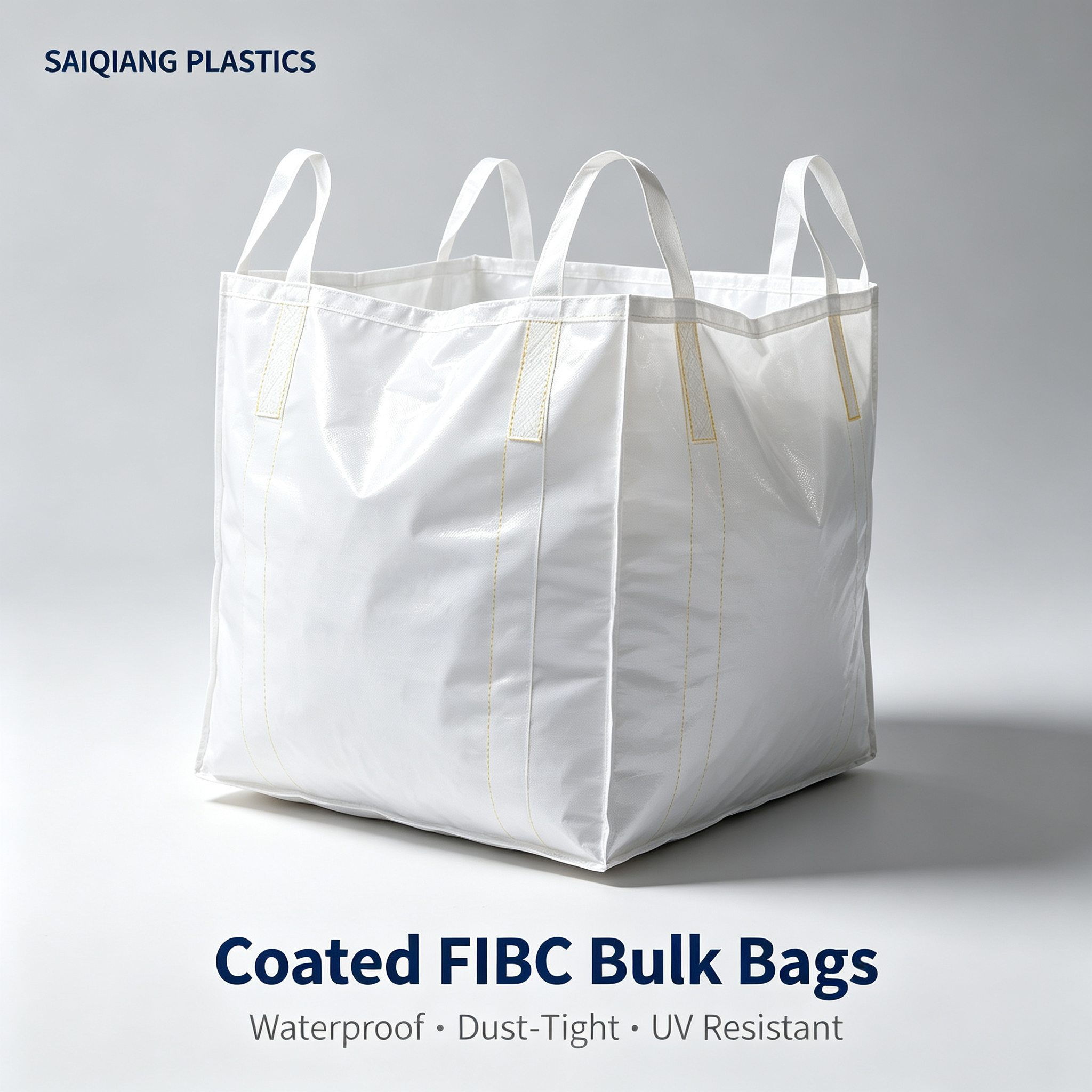
A bulk bag only pays for itself when it fills fast, seals tight and empties cleanly. On a coated fibc bag, the two spouts decide all three. The fill opening on top has to clamp onto your filling head, and the discharge spout underneath has to meter product into a hopper, mixer or packing line without a dust cloud. Both sit on a 20 to 50 micron coated shell that has to stay sealed from the filling station to the customer's intake, which is why spout design is worth settling before you compare prices.
The fill spout is sized around the equipment above it, not around the bag. A standard powder spout runs 350 to 500 mm in diameter with a tie-off sleeve long enough to clamp onto the filling head and fold shut afterwards; fine powders and dusty blends usually take a narrower 250 to 350 mm neck so the clamp seals on a shorter circumference and less product is left in the sleeve. Granules and pellets are more often loaded through a duffle top, because they flow without dust and a wide opening fills faster.
Three details cause most filling problems. A spout that is too short pulls off the filling head under load; one that is too long bunches up and traps product that later falls out in the warehouse. A spout without a reinforcing patch tears at the seam where the clamp bites. And a spout sewn into an uncoated panel lets powder migrate through the stitch holes, so the coating has to continue across the spout root.
A 300 to 400 mm discharge spout with an iris or petal closure lets one operator control the flow rate by hand and stop it cleanly when the receiving container is full. For a dust tight jumbo bag, the closure has to be sewn and coated so no powder escapes around the tie, and the spout should be long enough to reach into the hopper throat so the falling stream is enclosed rather than open to the air.
Where the load is moisture-sensitive or food-grade, the discharge spout is also where the inner liner is brought out and tied separately from the outer spout. Two closures, one fabric and one film, are what keep a hygroscopic product dry between the bag and the process.
Woven polypropylene is a mesh, and a mesh leaks. A laminated fibc body closes that mesh with a film layer, while a waterproof bulk bag relies on a polypropylene coating of 20 to 50 microns applied to the outer surface. The coating gives a smooth, impermeable surface that sheds rain in yard storage and holds fine powder inside the weave; the lamination gives a printable face for high-definition artwork. Many export programs use both: coated fabric for the body and spout roots, laminated panels where branding matters.
Coating weight is not a cosmetic choice. A light coating saves grams per bag but is the first thing to crack where the spout is folded and clamped repeatedly, and a cracked coating is where moisture enters. Seams are double-stitched with heavy-duty thread so coated panels hold under load, and UV stabilised fabric is what allows an uv resistant bulk bag to sit outdoors for extended periods without the coating chalking.
| Spout position | Typical option | Best for |
| Top fill spout | 350 to 500 mm, tie-off sleeve, reinforced root | Cement, minerals, chemical powders filled through a filling head |
| Top fill spout | 250 to 350 mm narrow neck | Fine and dusty powders where the clamp must seal tight |
| Open duffle top | Full-width opening with tie tapes | Granules, pellets, aggregates loaded by chute |
| Bottom discharge spout | 300 to 400 mm with iris or petal closure | Controlled emptying into hoppers and mixers |
| Discharge spout with liner | PE liner brought out and tied separately | Food ingredients and hygroscopic powders |
| Both spouts | Coated, dust-tight construction | Bag-to-process handling with no open transfer point |
Start from the filling head: its diameter, its clamp type and the height it sits above the floor decide the fill spout dimensions. Then take the receiving equipment: a hopper throat wants a long discharge spout, a screw conveyor wants a short one with a tight closure. After that come the product and the route, because a hygroscopic powder needs a liner, an outdoor stack needs UV stabilisation, and a fine powder needs coating across the whole body including the spout roots.
Send those four inputs and the bag can be built once instead of twice. Buyers who want to compare the base construction can review the 20 to 50 micron coated build used for outdoor storage, then send your spout dimensions and filling rate for a quotation with the artwork and quantity included.
Ordering by bag size alone is the first one: two bags of the same 90 x 90 x 110 cm body can have completely different spouts, and the spout is what the line feels. Specifying a discharge spout without checking the hopper height is the second, because a spout that cannot reach the throat turns a dust-tight bag into an open pour. Skipping the liner on a hygroscopic product is the third, and it usually shows up as caking at the destination rather than at the plant. The fourth is printing artwork across the spout root, where the fold and the clamp will wear the ink off within a few handling cycles.
Price is driven by body size, fabric weight, coating weight, spout configuration, whether a liner is fitted and how many colours are printed. Because two spout bags of the same capacity can differ substantially once the coating and closures are specified, quotations are built from your actual dimensions and quantity rather than a list price. Minimum order quantity starts at 500 pieces.
Match the fill spout to your filling head diameter and clamp type, then match the discharge spout to the receiving hopper or conveyor. Powders normally use a 350 to 500 mm fill spout with a tie-off sleeve, fine dusty products a narrower 250 to 350 mm neck, and granules a duffle top. Discharge spouts are usually 300 to 400 mm with an iris closure.
Emptying time depends on the product's flow behaviour and the discharge opening, not on the bag alone. A free-flowing granule through a 400 mm iris spout runs out in a couple of minutes, while a compacting or damp powder can bridge and needs operator help. That is why the closure type and spout length are specified against the product, not chosen from a catalogue.
Yes, with a liner. A food-grade PE liner of 50 to 200 microns is fitted inside the woven body and brought out through the discharge spout, so the product only touches film. That combination keeps moisture out during sea freight and stops fine powder sifting through the weave. The outer bag stays the structural element and carries the lifting loops.
واتس اب
صندوق البريد

يستخدم هذا الموقع ملفات تعريف الارتباط لضمان حصولك على أفضل تجربة على موقعنا.


 English
 Español
 Portugues
 Pусский
 Français


 واتس اب
 هاتف
 صندوق البريد
 رسالة
تعليق
(0)